Central Texas DX & Contest Club
Community
    Welcome
    About Us
    Meetings
    Email Reflector
    Spotlight
    Summerfest
DXing
    DXing
    DXCC Totals
    WAZ Totals
    DX Clusters
Contesting
    Contesting
    Club Competition
    Plaques
    Score Rumors
    W1AW/5 2002
Members
    Officers
    Members
    Merchandise
    Wallpaper
    Photos
    Maps
    Constitution
    Silent Keys
    In The News
Resources
    Presentations
    Local Regs
    IC Graph
    Links
Phil Duff NA4M
Photo of 
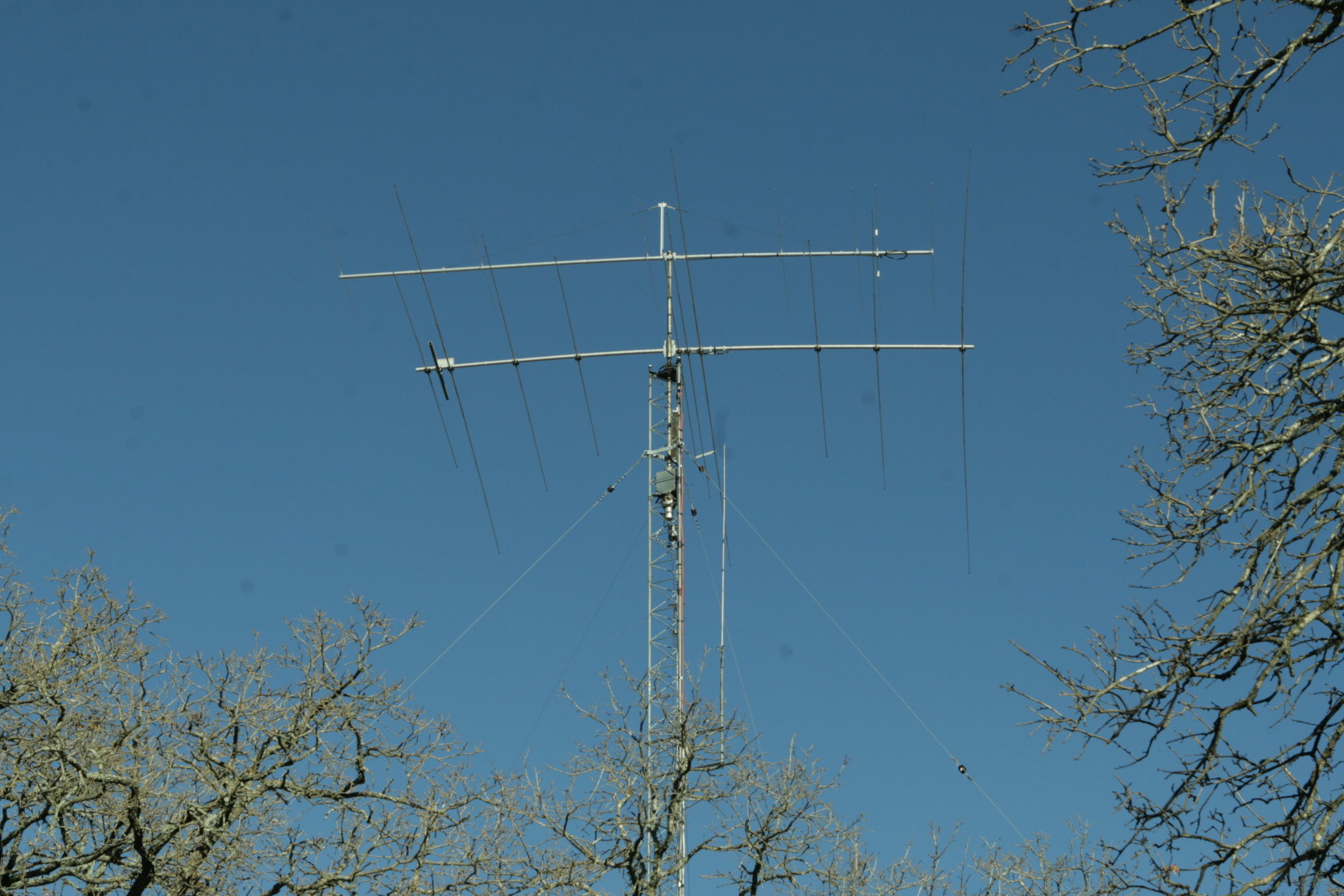
      NA4M tower, March, 2006

Inside Phil's station is a Yaesu FT-1000MP transceiver with an INRAD 4 kHz roofing filter, an ETO/Alpha Power 91b 1500 watt linear amplifier, a Ten-Tec 1208 20 meter to 6 meter transverter, a Mirage A1015 150 watt 6 meter amplifier, and an Amteritron ATR-30 HF antenna tuner. The station computer is homebrew and has an AMD Athlon T-Bird 1.2 GHz CPU and 1 GB of RAM. Phil uses DXLab for daily logging and DX Cluster use and WriteLog when operating in contests. For 2 meter FM operation, a Yaesu FT-1802M 50 watt base radio and an Yaesu VX-170 HT are available. For HF and 2M mobile operation, Phil uses an Icom IC-706 MkII trasnceiver with a High Sierra HS-1500 HF screwdriver vertical and a 1/4 wavelength 2 meter whip antenna.

A Cushcraft Ringo Ranger for the 2 meter band is side-mounted at about 55 feet above ground for FM use. Not visible in the photo is a garage roof tripod support with a four-element HyGain Yagi for 6 meters mounted 27 feet above ground. The 6 meter antenna is turned by a HyGain TailTwister rotor and fed with 7/8" heliax for low loss.

Seven sections of Rohn 45G tower at NA4M support a Bencher Skyhawk triband antenna for 20 meters, 15 meters, and 10 meters at 73 feet above ground, and a Cushcraft 40-2CD two-element 40 meter antenna at 78 feet above ground. The Skyhawk and the 40-2CD are turned by a refurbished WWII-vintage aircraft prop-pitch motor controlled by an M2 rotor controller.
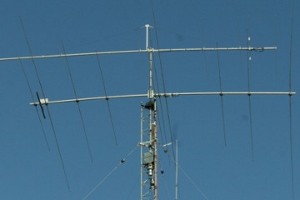
The Skyhawk replaces a stacked/phased pair of HyGain TH7s. Phil wanted to use one of the newer generation of computer designed antennas after many years of service from the TH7s. One of the old HyGain antennas began service in 1971 as a TH6 and only later converted to a TH7.

All currently available triband, quadband, and log-periodic directive antennas were studied and evaluated over the last few years before the decision was made to go with the Skyhawk. The Skyhawk has a total of 10 monoband elements, and there are no traps or linear loading in any element. The antenna has three elements on 20 meters, three elements on 15 meters, and four elements on 10 meters. The three separate driven elements are all fed in parallel simultaneously by a common coax and balun. The boom is 24 feet long and has double- and triple-wall construction; no boom support truss is needed. The antenna also has torque and wind compensators to ease the strain on the rotor.

Another key feature that sold Phil on this antenna was its mechanical design, which includes its simple feed system and great element to boom mounting hardware. The only pop rivets in the antenna are used to connect the element tubing sections together. All other fastener hardware is stainless steel bolts and screws. So far, Phil feels that the electrical and mechanical performance of the Skyhawk has met or exceeded his expectations in all respects.

Close to the top of the tower is a wooden side arm that supports an 80 meter full-wave delta-loop antenna that is fed one quarter wavelength from the apex for low angle vertical polarization. The tower also is shunt-fed for 160 meters over sixteen in-ground short radials. Out in the south side yard is a pair of K9AY desgin receive-only loops used for 80 meters and 160 meters. Phil switchs between the loops with a K9AY Loop Control remote switch box that has an in-shack control box.

-----------------------------------------------------------------------------

Send comments to: wm5r@wm5r.org
Webmaster: Ken Harker WM5R
Web server resources courtesy of kkn.net
Last updated: 15 July 2008